Childhood Rhythms: The Rhythms that Hold Us
We are rhythm-seeking, meaning-making people. Rhythms help ground us in a world where much shifts and swirls around us. They give us something we can count on. There is a certain felt safety in knowing that some things will happen again and again.
But rhythms are different from rigid routines. A rhythm gives us a framework without requiring everything to happen exactly the same way. There is room for flexibility, adaptability, and the unexpected.
Dr. Dan Siegel uses the image of a river to describe well-being. We are most well when we are able to stay in the flow of the river. We can move toward one bank, where there is chaos, or toward the other bank, where there is rigidity. Rhythms can help us stay in the flow—and they can also give us something to return to when we inevitably bump up against one of those banks.
Our children are just like us. They experience big emotions, disappointment, transitions, grief and loss. Their worlds are constantly changing as they grow and develop. Rhythms can give them something familiar to return to in the midst of all that change.
And perhaps it is worth thinking about our own childhoods. What rhythms made up your days? What could you count on? Were those rhythms grounding and life-giving? Or did things feel extremely rigid—or so chaotic that you never quite knew what to expect?
I think about this often because one of the challenges I see and experience in our current culture is how difficult it can be to make room for rhythms at all. The pace around us is fast. So much of our time is spoken for.
How do we have a slow, pancake Saturday morning when most Saturday mornings we are rushing out the door? And maybe the answer isn't that we have to create the slow, pancake Saturday morning. Maybe we simply begin by asking what matters to us.
If your family values sports and your Saturday mornings are spent rushing out the door to games, that may be an important rhythm for your family. Perhaps the rhythm of connection happens somewhere else—a Sunday morning breakfast, a Friday night pizza and movie, an evening walk after dinner.
There is no formula for what a meaningful family rhythm has to look like. One way to begin creating rhythms for the children in our lives is to consider what we value. When we name what matters to us, we may begin to notice the rhythms that naturally grow from those values.
Rhythms can happen daily—even multiple times a day. We have morning rhythms, noontime rhythms, afternoon rhythms, and evening rhythms. We have weekly rhythms, and other things that happen monthly, seasonally, or yearly.
Like the seasons, these rhythms can give us a framework—a kind of scaffolding that supports us while still leaving room for life to unfold in its particular details.
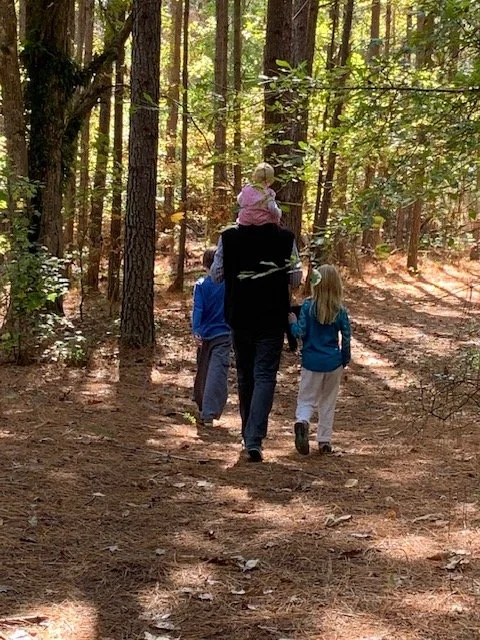
For one family, a rhythm might be gathering around the table for dinner. For another, it might be time outside together, hiking, biking, exploring, or playing in the yard. It might be board games, a weekly movie night, traveling to places near and far, or cheering from the sidelines at a child's game. It might be the ritual of tucking a child into bed, reading a book together, or saying prayers.
These things may seem small, but over time, they become part of the story of a childhood. And perhaps that is part of what makes rhythms meaningful. They don't keep life from being hard. They don't prevent grief, disappointment, change, or big emotions. They simply give us places to return to.
A familiar meal. A favorite book. The same bedtime ritual. A Saturday tradition. A walk together. A gathering around the table. Little reminders that, even when much is changing, some things remain.
Your rhythms don't have to be perfect to be good. So perhaps the invitation is simply to notice.
What do your days feel like?
What rhythms have been meaningful in your own childhood?
What rhythms are meaningful to you now?
And what might you want to make a little more room for in the lives of the children you love?